Restless Legs Symptoms: The 4 Signs That Confirm It (and What Most People Mistake It For)
For 6 years my neighbor treated the wrong problem. Here’s how to tell in 60 seconds, and what actually helps.


Restless legs causes a strong urge to move your legs, usually with an uncomfortable feeling deep inside them: crawling, pulling, tingling, aching, itching or "electric."
Four signs confirm it:
- An urge to move your legs
- It starts or gets worse at rest, when you sit or lie still
- Moving brings relief, at least while you keep moving
- It's worse in the evening and at night
But knowing the name is only half of it. The other half is why your legs do this, and that part almost never comes up.
For six years, my neighbor Susan thought she had bad circulation.
She's 67, a retired teacher, the kind of person who reads every label twice.
She bought compression socks. She slept with her legs up on two pillows. She cut out salt.
Nothing changed. Not one night.
Then one summer evening on her porch, she tried to describe it to me.
"It's like soda fizzing inside my calves," she said. "And if I don't get up and move, I feel like I'll scream."
I put my coffee down.
"Susan, that's not your circulation. That's restless legs."
She started crying. Not because it was bad news.
Because after six years and three doctors, someone finally had a name for it.
If any of this sounds familiar, give me 60 seconds. By the end of the next box you'll know if this is you.
- The words people use for it (you'll likely recognize yours)
- The 4 signs that confirm it, as a quick tap-through check
- The 2 problems it's most often mistaken for, and how to tell them apart
- What's really behind the symptoms, and why nobody mentions it
- What helps tonight, and what helps over the next few weeks
What Restless Legs Really Feels Like
People almost never say "pain." Instead they say:
- "Creepy-crawly," like bugs under the skin
- "Fizzing," like soda in the veins
- A pulling or tugging deep in the calf
- "Electric," buzzing, jittery
- An itch you can't scratch, because it's inside the leg
- A deep ache that only moving eases
Most people feel it in the calves. It can be in the thighs or feet, and sometimes the arms. Usually both legs, sometimes switching sides.
And some people can't describe it at all. They just know they HAVE to move.
Now, the test.
The 4 Signs That Confirm It
The 2 Problems It Gets Mistaken For
Susan isn't unusual. Restless legs gets mixed up with these two all the time:
A sudden, painful knot in one muscle. You can feel it go hard. Stretching releases it, and it doesn't come back just because you sit down.
Aching or heaviness that's usually worse when you walk and better when you rest. The exact opposite of restless legs.
An urge to move that's worse when you rest, better when you move, and worst at night.
That's why the socks did nothing for Susan. She spent six years treating the wrong problem.
But here's the question that kept nagging at me after that night on the porch:
If it's not her circulation... what IS making her legs do this?
What's Really Behind the Symptoms
The answer isn't in your legs. It's in your brain.
Your brain uses iron to make dopamine, the chemical that keeps movement signals calm while you rest. Think of it as the brake pedal for your legs.
Brain studies from Johns Hopkins and other centers have found that in many people with restless legs, the movement-control areas of the brain hold less iron than they should, even when a routine blood test looks normal.
And dopamine activity dips naturally at night.
A soft brake pedal plus a nightly dip. That's why the symptoms show up right when you lie down, like clockwork.
Then Why Did 3 Doctors Miss It?
Susan asked me that too. Here's the honest answer:
The symptoms happen at night. The appointment happens at 10 AM. By then your legs are perfectly calm, and there's nothing to see.
The blood test checks the wrong place. It measures iron in your blood, not your brain. If the number clears the lab's bar, the conversation ends.
Quick fixes are easier. "Try compression socks" fits in a 15-minute visit. Explaining brain iron doesn't.
So people get socks. Or creams. Or sleeping pills that knock them out while their legs keep going.
And the part that matters goes unsaid.
What Helps: Tonight, and Over Time
Once you know what's behind it, you have two jobs, not one:
- Calm the legs tonight, so you can actually sleep
- Work on the iron side over the next weeks, so there are fewer bad nights to calm
Most products only do one. That's why most people end up disappointed.
For tonight: why Susan's first good night started at her feet
Walking helps. Stretching helps. Rubbing your legs helps. But only while you're doing it.
What Susan needed was something that kept helping after she lay down.
Many people with restless legs notice that firm pressure on the feet or legs, like a good squeeze or a massage, helps their legs settle. The problem? Nobody can hold your feet all night.
So I gave her RLStrap™, a padded foot wrap she puts on at bedtime. It holds firm, steady pressure across the arch of the foot all night long, hands free.

- Pressure on the arch, not the calf. The padded part sits across the arch of your foot and stays there, firm and steady.
- All night, hands free. What a good squeeze or massage does, without anyone having to stay awake holding your feet.
- You control the pressure. Adjustable Velcro strap: firm but comfortable, never painful.
- Made to sleep in. Latex-free breathable fabric with foam cushioning. Fits US shoe sizes 5 to 13.
- Drug-free and reusable. One wrap, night after night.
Results vary from person to person. But it's something you can try the same night it arrives.
Over time: the iron side
The wrap helps the night you wear it. It doesn't change what's going on in the brain.
For that, Susan takes RLStop™ Day & Night, two formulas built around the brain-iron findings and timed by the clock: iron in the morning when it absorbs best, magnesium at night when your legs need it.
- Iron in the morning. That's when your body absorbs it best. One moderate dose, not a stomach-wrecking bomb.
- Vitamin C with the iron. It helps your body absorb it. Most iron pills come alone.
- B6 in the daytime too. Your body uses it to make dopamine, the "brake pedal" for your legs.
- Magnesium at night. Away from the iron, and right when your legs need it.
No prescription needed. Vegan, non-GMO and gluten free, made in an FDA-registered facility. As low as $0.82 per capsule: less than a cup of coffee a day.
Give it time. Iron stores build over weeks, not days. We suggest 90 days of steady use. Results vary from person to person.
One honest note: if you've been told your iron is high, or you have an iron-storage condition like hemochromatosis, RLStop is not for you.
Susan uses both now. The wrap at bedtime. The two capsules every day. One for tonight, one for the reason behind it.
The Results

In the last 24 months, over 18,000 people have used the RLStop Protocol.
The results?
94% report "significant or complete" relief from the urge to move within 3 weeks
87% were able to fall asleep within 20 minutes without twitching
92% showed optimized ferritin levels in follow-up blood panels
But my favorite statistic?
Almost zero cases of "augmentation": the side effect that makes prescription dopamine drugs problematic for long-term use.
Check out what real users are saying:
"I've had RLS for 18 years and I have a drawer full of compression socks, weighted blankets, and expired prescriptions. Nothing worked long-term. I was skeptical about this 'dual formula' thing, but I was desperate. It took about 3 weeks to really kick in, but suddenly I realized I wasn't pacing at midnight anymore. First time in nearly two decades. I'm a customer for life."
- Janet M., Phoenix, AZ
"My doctor put me on a prescription and within 6 months my RLS was TEN TIMES WORSE. Classic augmentation. I was ready to give up. Found RLStop through a forum. Within a month I was sleeping again. My neurologist was shocked at my blood panel improvements. Now he recommends it to other patients."
- Marcus T., Seattle, WA
"I'm 69. They told me RLS was just 'part of aging' and I'd have to live with it. Been using RLStop for 5 months. Just took a 6-hour flight to see my grandkids without terror. Doctor can't believe the change in my ferritin levels."
- Dorothy P., Tampa, FL


The Cost Comparison

Let me show you what treating restless legs REALLY costs in America:
Sleep Specialist + Medication Route:
Monthly specialist visits: $250-400
Prescription RLS medications: $180-350/month
Sleep studies: $3,000-5,000
Annual total: $8,000 - $12,000
(plus the exhaustion, dependency risk, and augmentation nightmare)
Natural Supplement Route (Most Brands):
Separate iron pills: $25/month
Separate magnesium: $30/month
Separate B-vitamins: $20/month
Total: $900/year (for uncoordinated, weak formulas that don't work together)
Prescription Dopamine Agonist Route:
Prescription medication: $200-350/month
Neurologist visits (quarterly): $1,200/year
Augmentation treatment when it fails: $$$
Total: $3,600+/year (with 40-60% risk of making RLS WORSE)
Traditional medical approaches focus on ongoing management rather than addressing the root cause.
This creates a cycle where patients keep coming back for refills and follow-up appointments.
Here's the difference with RLStop:
The RLStop Protocol costs less than one sleep specialist visit.
Your Two-Part Night Plan
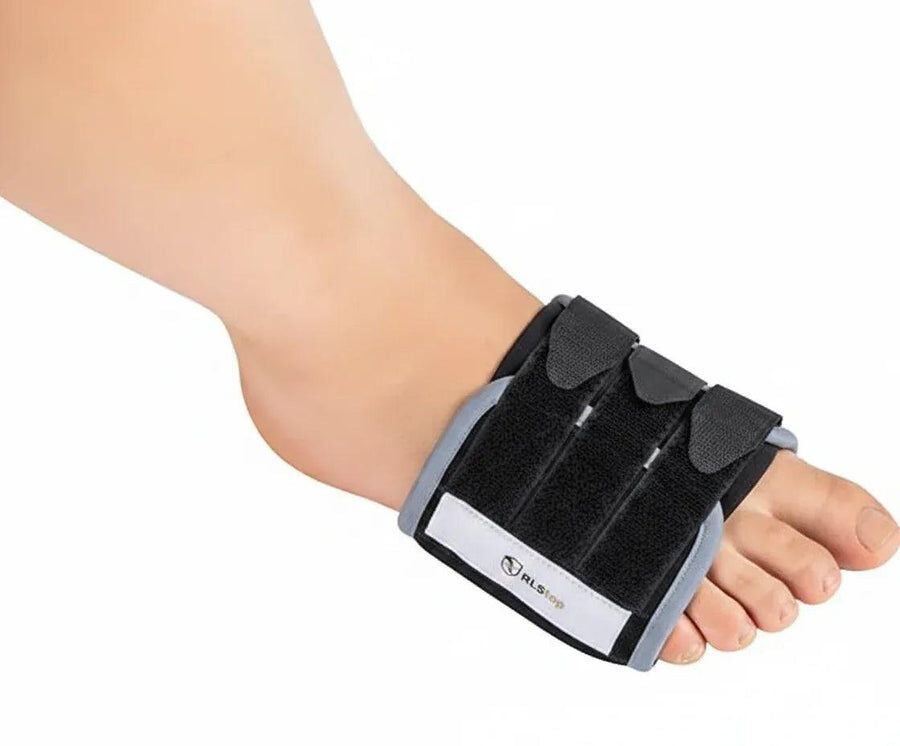

RLStrap for bedtime pressure, starting tonight. RLStop for the iron side, over time.
90-Day Money-Back Guarantee

Look, I get it.
You've been burned before.
Spent money on "miracle fixes" that turned out to be expensive paperweights.
So here's my promise:
You get 90 full days to decide.
Order today. Look it over. Start when you're ready.
If you change your mind within 90 days, send back any unopened bottles and the unused wrap...
...and you get your money back for them.
✓ 90 full days to decide.
✓ Refund to your original payment method for every unopened bottle and unused wrap.
✓ Just email support@rlstop.com.
In the original packaging. Return shipping is paid by the customer.
Where Is Susan Today?
The compression socks are in a drawer. The two pillows are back at the head of the bed.
She told me last month:
"The worst part wasn't my legs. It was six years of not knowing what it was. Once I knew, I could finally do something about it."
Comments (13)


Reader Questions