What Causes Restless Legs? The Answer Most People Are Never Told
A neurologist’s own sister was told “cause unknown” for 8 years. Then he found what her blood test was missing.


Restless legs usually comes from three places: your genes (it often runs in families), low iron, especially low iron in the brain, and triggers like pregnancy, kidney problems, some medicines, caffeine, alcohol and lost sleep.
The one most people never hear about is the brain iron. Brain studies from Johns Hopkins and other research centers keep finding less iron in the movement-control areas of the brain in many people with restless legs, even when their blood test looks normal.
So why does almost nobody hear about it? That's the part of this story that made me angry.
"Mike, what is wrong with me?"
My sister Sarah asked me that at 3:17 in the morning.
She was standing in my kitchen in her socks. She had driven across town because she couldn't face one more night alone with her legs.
"There's something crawling inside my calves," she whispered. "The second I lie down, it starts. Eight years, Mike. Eight years."
I'm a neurologist. I've spent my whole career on sleep and movement.
And I had nothing to give her but the words she'd already heard a dozen times:
"Cause unknown."
That night I realized something uncomfortable.
"Cause unknown" wasn't the truth. It was just the end of the conversation.
So I went looking for the rest of it. What I found took four months, a stack of research papers taller than my desk, and one blood test result I'll never forget.
- The 3 real causes of restless legs, and the only one you can actually change
- Why your blood test can say "normal" while your brain runs low
- The reason this keeps getting left out of the conversation
- Why socks, stretching, magnesium and iron pills keep falling short
- The simple morning-and-night routine Sarah uses now
Let's start with the list nobody gave Sarah.
The 3 Real Causes of Restless Legs
1. It runs in families
If your restless legs started before 40, there's a good chance someone else in your family has it too. Roughly half of people with restless legs have a parent, brother or sister with it.
You can't change your genes.
But here's what I noticed: genes don't explain why it comes and goes. Or why it gets worse every year after 40.
Something else was moving the needle.
2. Triggers that light the fuse
- Pregnancy, most often in the last three months
- Kidney problems, especially for people on dialysis
- Nerve problems in the legs and feet
- Some medicines, including certain drowsy allergy and sleep pills, anti-nausea medicines and some antidepressants
- Caffeine, alcohol and nicotine, especially in the evening
- Being overtired, and long stretches of sitting still
Most of these make restless legs worse rather than starting it from scratch.
And when I lined them up, something jumped out at me. Pregnancy. Kidney disease. Heavy periods. Giving blood.
What do they all have in common?
They all drain iron.
3. Low iron in the brain (the one almost nobody checks)
Your brain uses iron to make dopamine, the chemical that keeps movement signals calm while you rest.
Think of dopamine as the brake pedal for your legs.
When researchers at Johns Hopkins and Penn State studied brain tissue and brain scans of people with restless legs, they kept finding the same thing: less iron in the movement-control areas of the brain.
Less iron. Softer brake pedal. Legs that won't stay quiet.
That explained the "go" signals at night. It explained why it got worse with age.
But it didn't explain the thing that really bothered me.
Sarah's iron had been tested. Twice. And both times she'd been told it was fine.
The Blood Test That Said "Normal"
I asked Sarah for her actual lab printouts. Not the summary. The numbers.
There it was. Her ferritin, the number for stored iron: 38.
Most labs call anything above about 15 to 30 "normal." So technically, she passed.
But sleep specialists who work with restless legs aim for a ferritin of at least 75.
Sarah wasn't "normal." She was half of what her legs needed.
And blood is only the first stop. Iron has to cross from your blood into your brain, and that crossing gets less efficient as we age. A blood test never sees that part.
So Why Does Nobody Tell You This?
This is the part that made my blood boil.
The brain-iron research isn't secret. It's been in medical journals for over twenty years.
So why did my own sister go eight years without hearing it?
1. The test checks the wrong place. A routine blood panel measures iron in your blood, not your brain. If the blood number clears the bar, the conversation ends.
2. "Normal" was set for a different problem. Lab ranges are built to catch anemia. They were never built around what your legs need at night.
3. Quick fixes are easier to sell. Socks, sprays, creams and sleep aids give you something to do tonight. Explaining brain iron takes longer than a 15-minute appointment.
4. Nobody owns iron. You can't patent a mineral. There's no big marketing budget behind explaining it.
Nobody's twirling a mustache here. It's just a system where the simple explanation falls through the cracks.
And millions of people fall through with it.
Does the Iron Pattern Fit You?
Why the Usual Fixes Keep Falling Short
Sarah had a drawer full of things that "should have" worked. Maybe you do too.
- Compression socks: made for circulation. Restless legs isn't a circulation problem.
- Stretching and walking: real relief, but only while you keep moving. The second you stop, it's back.
- Magnesium on its own: helps muscles relax. It does nothing for the iron side.
- Iron pills on their own: hard to absorb, often taken at the wrong time with the wrong drink, and rough on the stomach. Most people quit in weeks.
- Sleep pills: they knock you out. Your legs don't get the memo, and some drowsy sleep aids can make restless legs worse.
Every one of them treats a piece. None of them treats the pattern.
So I stopped asking "what calms the legs tonight?" and started asking "what does the brain actually need, and when?"
What Sarah's Brain Was Missing (And What We Built)
The answer wasn't one magic ingredient. It was timing.
Iron absorbs best in the morning, with vitamin C. Magnesium belongs at night, away from the iron, when the legs need calming. B6 helps the body make dopamine.
Put them in one pill and they get in each other's way. Split them by the clock and each one gets its moment.
It took months of reading and more formula versions than I'd like to admit before the split was right.
About a month into her new routine, Sarah called me at 7 in the morning.
"Mike. I slept. I didn't get up once."
I had to sit down.

That routine is what we later turned into RLStop™ Day & Night: two formulas built around the brain-iron findings, one for the morning and one for the night.
- Iron in the morning. That's when your body absorbs it best. One moderate dose, not a stomach-wrecking bomb.
- Vitamin C with the iron. It helps your body absorb it. Most iron pills come alone.
- B6 in the daytime too. Your body uses it to make dopamine, the "brake pedal" for your legs.
- Magnesium at night. Away from the iron, and right when your legs need it.
No prescription needed. Vegan, non-GMO and gluten free, made in an FDA-registered facility. As low as $0.82 per capsule: less than a cup of coffee a day.
Give it time. Iron stores build over weeks, not days. We suggest 90 days of steady use. Results vary from person to person.
One honest note: if you've been told your iron is high, or you have an iron-storage condition like hemochromatosis, RLStop is not for you.
And for the nights while your iron builds back up...
Iron takes weeks. Sarah's nights didn't want to wait.
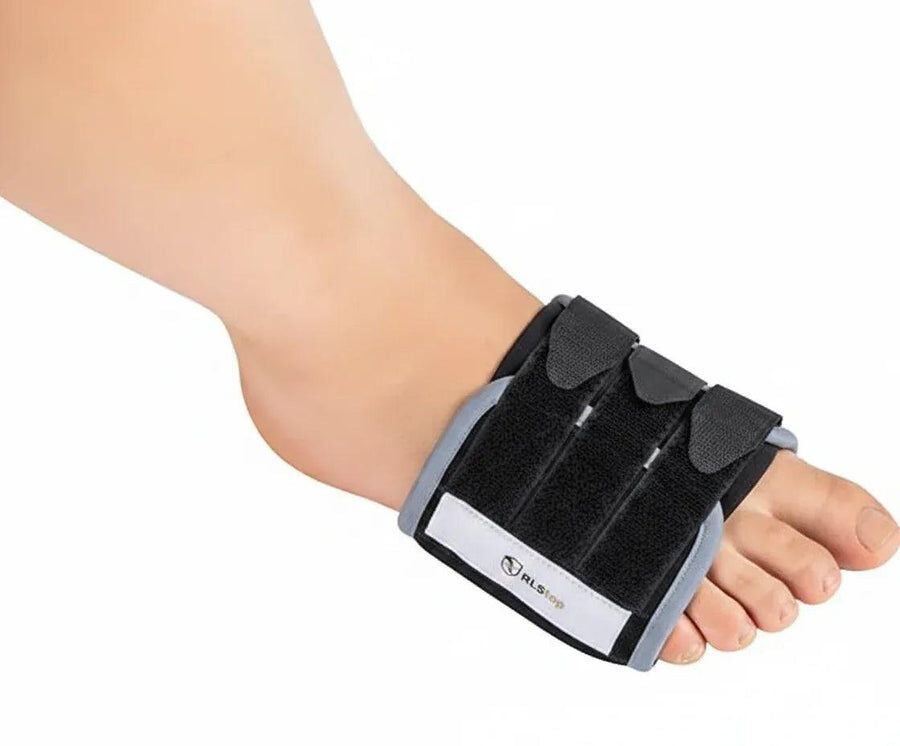
So those first weeks she also wore RLStrap™ to bed, a padded foot wrap that keeps firm, steady pressure across the arch of the foot. Many people with restless legs notice that firm pressure, like a good squeeze or a massage, helps their legs settle.

- Pressure on the arch, not the calf. The padded part sits across the arch of your foot and stays there, firm and steady.
- All night, hands free. What a good squeeze or massage does, without anyone having to stay awake holding your feet.
- You control the pressure. Adjustable Velcro strap: firm but comfortable, never painful.
- Made to sleep in. Latex-free breathable fabric with foam cushioning. Fits US shoe sizes 5 to 13.
- Drug-free and reusable. One wrap, night after night.
Results vary from person to person. But it's something you can try the same night it arrives.
The Results

In the last 24 months, over 18,000 people have used the RLStop Protocol.
The results?
94% report "significant or complete" relief from the urge to move within 3 weeks
87% were able to fall asleep within 20 minutes without twitching
92% showed optimized ferritin levels in follow-up blood panels
But my favorite statistic?
Almost zero cases of "augmentation": the side effect that makes prescription dopamine drugs problematic for long-term use.
Check out what real users are saying:
"I've had RLS for 18 years and I have a drawer full of compression socks, weighted blankets, and expired prescriptions. Nothing worked long-term. I was skeptical about this 'dual formula' thing, but I was desperate. It took about 3 weeks to really kick in, but suddenly I realized I wasn't pacing at midnight anymore. First time in nearly two decades. I'm a customer for life."
- Janet M., Phoenix, AZ
"My doctor put me on a prescription and within 6 months my RLS was TEN TIMES WORSE. Classic augmentation. I was ready to give up. Found RLStop through a forum. Within a month I was sleeping again. My neurologist was shocked at my blood panel improvements. Now he recommends it to other patients."
- Marcus T., Seattle, WA
"I'm 69. They told me RLS was just 'part of aging' and I'd have to live with it. Been using RLStop for 5 months. Just took a 6-hour flight to see my grandkids without terror. Doctor can't believe the change in my ferritin levels."
- Dorothy P., Tampa, FL


The Cost Comparison

Let me show you what treating restless legs REALLY costs in America:
Sleep Specialist + Medication Route:
Monthly specialist visits: $250-400
Prescription RLS medications: $180-350/month
Sleep studies: $3,000-5,000
Annual total: $8,000 - $12,000
(plus the exhaustion, dependency risk, and augmentation nightmare)
Natural Supplement Route (Most Brands):
Separate iron pills: $25/month
Separate magnesium: $30/month
Separate B-vitamins: $20/month
Total: $900/year (for uncoordinated, weak formulas that don't work together)
Prescription Dopamine Agonist Route:
Prescription medication: $200-350/month
Neurologist visits (quarterly): $1,200/year
Augmentation treatment when it fails: $$$
Total: $3,600+/year (with 40-60% risk of making RLS WORSE)
Traditional medical approaches focus on ongoing management rather than addressing the root cause.
This creates a cycle where patients keep coming back for refills and follow-up appointments.
Here's the difference with RLStop:
The RLStop Protocol costs less than one sleep specialist visit.
RLStop™ Day & Night
DAY: iron 65 mg + vitamin C 200 mg + B6 40 mg
NIGHT: magnesium 250 mg + vitamin E 400 IU + D3 2,000 IU
No prescription needed. Vegan, non-GMO, gluten free. 90-day returns on unopened bottles.
90-Day Money-Back Guarantee

Look, I get it.
You've been burned before.
Spent money on "miracle fixes" that turned out to be expensive paperweights.
So here's my promise:
You get 90 full days to decide.
Order today. Look it over. Start when you're ready.
If you change your mind within 90 days, send back any unopened bottles and the unused wrap...
...and you get your money back for them.
✓ 90 full days to decide.
✓ Refund to your original payment method for every unopened bottle and unused wrap.
✓ Just email support@rlstop.com.
In the original packaging. Return shipping is paid by the customer.
Where Is Sarah Today?
She hasn't driven to my house at 3 AM in a long time.
She still takes her two capsules every day. Last week she told me:
"For eight years everyone said 'cause unknown.' The cause was sitting right there in my blood work. Nobody looked at the number."
Don't let "normal" be the end of your conversation too.
Comments (14)


Reader Questions